The Faculty of Health Sciences (FGW) considers itself and has acted as a hub for health science research in Brandenburg since its foundation. It was founded at the instigation of the state with the declared aim of strengthening cooperation between university and non-university scientists in the state by intensifying joint research activities. In this way, effective concepts for improved healthcare can be developed in the long term.
One of the core ideas behind the FGW concept was to strengthen the research topics already established at the institutions, which are networked across universities by the faculty. The subjects of the newly created professorships have been chosen accordingly. They have an impact on the respective institutions and network the already established professorships, which are located in different faculties. The main topics will continue to be pursued at the institutions with the newly appointed FGW professorships, even after the establishment of university medicine in Lusatia.
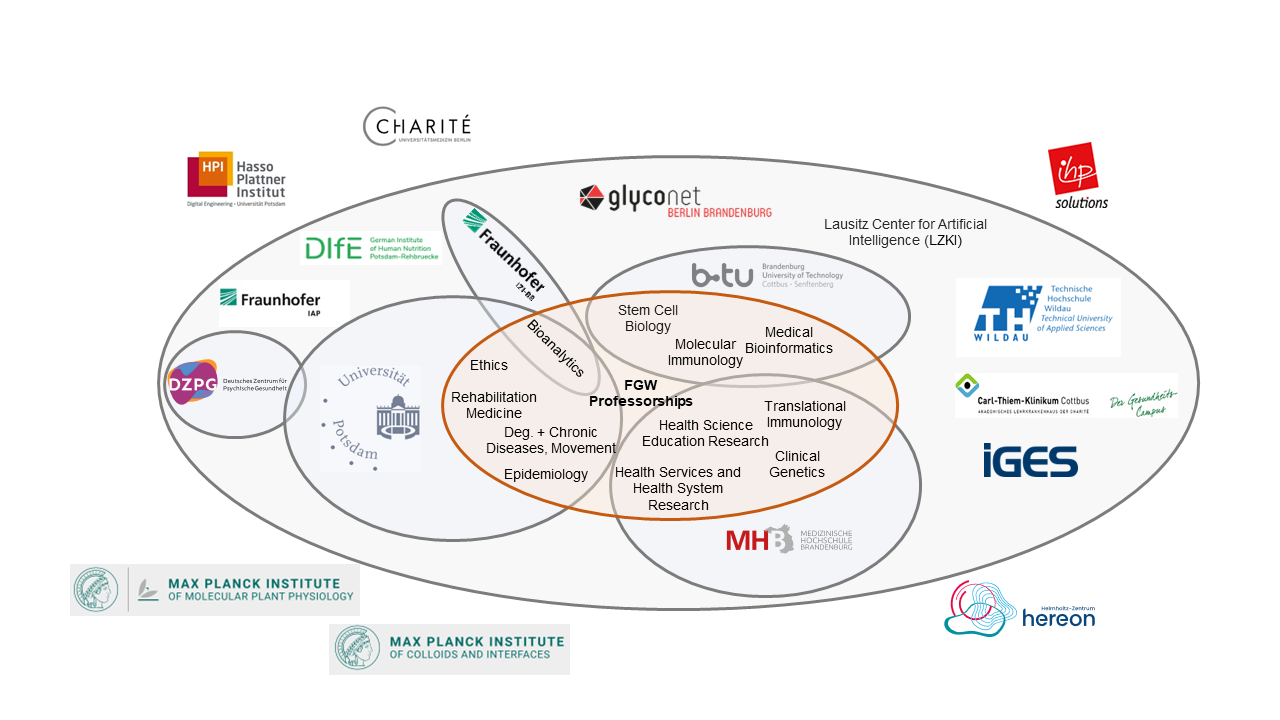
The 12 FGW professorships form the core of the network, which links the health science subjects of the three partner universities with each other, but also maintains cooperation with non-university research institutions and the state’s universities of applied sciences.
A total of 12 new professorships have been established, each appointed to the FGW by one of the three sponsoring universities.
As part of a joint research profile, members have formulated the goal, under the overarching theme of Healthy Aging, to promote health and well-being throughout the lifelong aging process through prevention at various levels, using an interdisciplinary approach. Key focus areas include mental health and well-being through strengthening health literacy, taking into account ethical aspects and the use of digital methods.
The newly established professorships enable the training of professionals in the fields of health services research and public health. Degree programs have been developed for both disciplines, ensuring that skilled professionals will be available in the future for the development of new healthcare concepts in the region. Two additional degree programs are currently being conceptualized to expand offerings in the fields of Data Sciences and Ethics.
Another area of impact for the faculty is the transfer and translation of the results of collaborative health sciences research, both for application in medical and nursing practice as well as in economic sectors.