The Faculty of Health Sciences (FGW) conducts research at its three supporting universities: Brandenburg University of Technology Cottbus-Senftenberg (BTU), Brandenburg Medical School Theodor Fontane (MHB), and University of Potsdam (UP).
The faculty views health sciences as an interdisciplinary field that deals with the physical, mental, and social conditions of health and well-being as well as their systemic connections. It examines ways to maintain and improve health and well-being at several levels: from the gene/molecule in the cell through the organism to the surrounding environment. Unlike medicine, the faculty does not focus on the treatment of diseases but on the maintenance of health. Both disciplines complement each other. The goal of the faculty can be summarised as follows: The Faculty of Health Sciences (FGW) aims to make a significant contribution to better health for the aging population of Brandenburg.
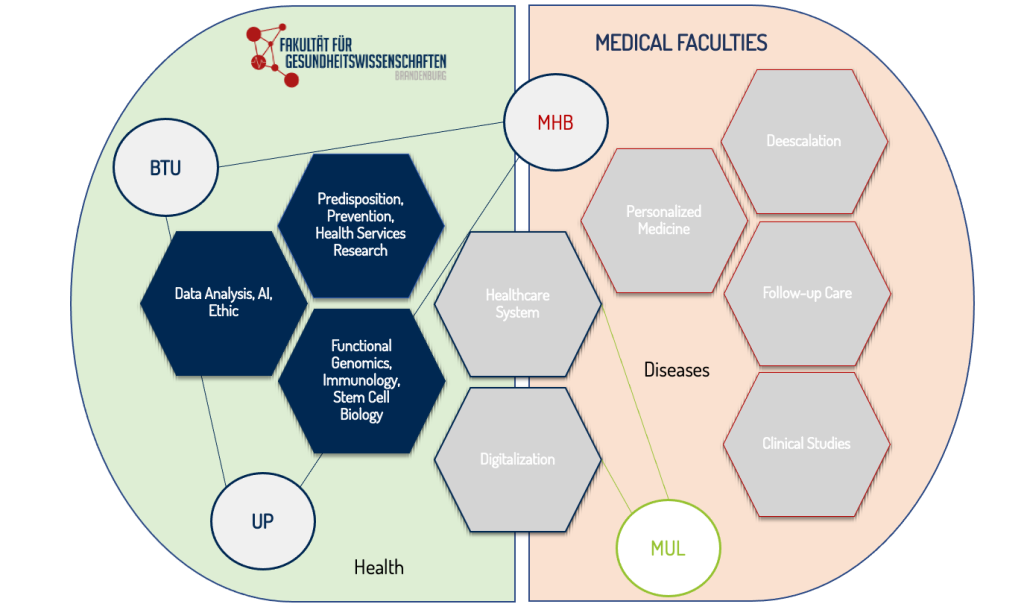
Schematic representation of the topics within the Faculty of Health Sciences (FGW) in relation to the topics of the medical faculties of the Brandenburg Medical School (MHB) and the Medical University Łódź (MUL).
The research is interdisciplinary, combining molecular and non-molecular approaches and highlighting health and the maintenance of health from the cellular level through the organism (human) to the environment and society in which the human lives.
Our health is determined by our genetic predisposition, lifestyle, and environmental factors. Efforts to maintain or improve our health through prevention must therefore address all three areas. The individual health status defines whether this can be achieved through primary, secondary, tertiary, or quaternary prevention. The professorships of the Faculty of Health Sciences (FGW) address this within their research by examining the mechanisms at the molecular/cellular level, at the level of the organism (human), or the environment/society.
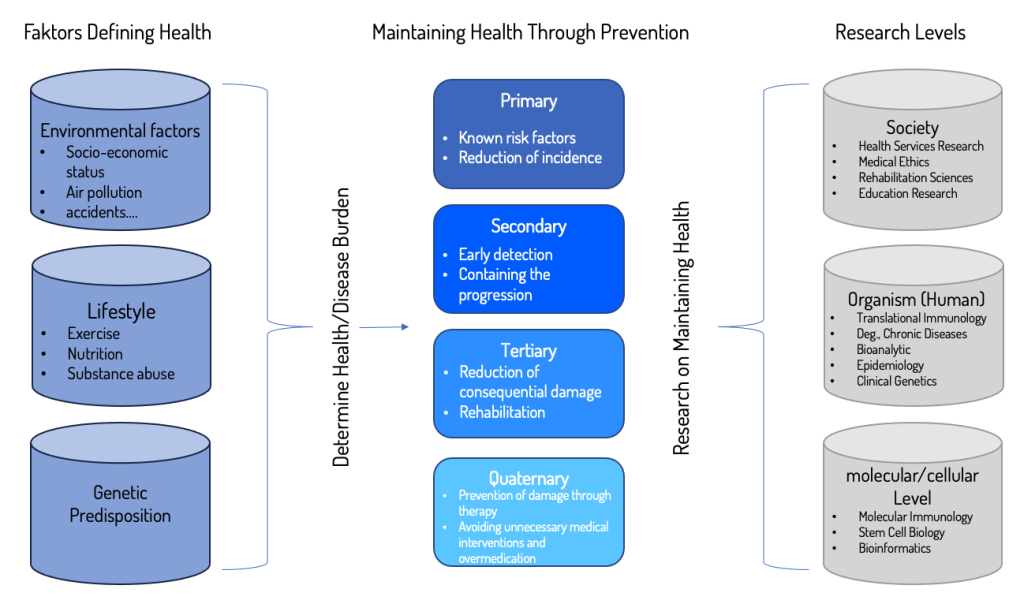
The faculty aims to maintain health even in old age. In our society, health in old age is usually not threatened by infections or genetic variants but is determined by a combination of genetic predisposition, lifestyle, and environmental influences. Within these so-called non-communicable factors, we focus on the following aspects:
The focus is on primary, secondary, and tertiary non-pharmacological prevention through the improvement of health literacy and health behavior (particularly in relation to nutrition and exercise) to maintain or regain individual and societal health. For this purpose, risk groups should be identified and addressed, and new approaches of digitalized healthcare should be utilized, which include evidence of new markers or mediators with biotechnological sensors. The digitalization approach also includes the so-called digital prevention twin (modeled after the digital twin), which the professorships of the Faculty of Health Sciences (FGW) are working on collaboratively.
Further details on the research focus of our professorships can be found here.
Downloads
Fakultätsentwicklungsplan (23.03.2026)