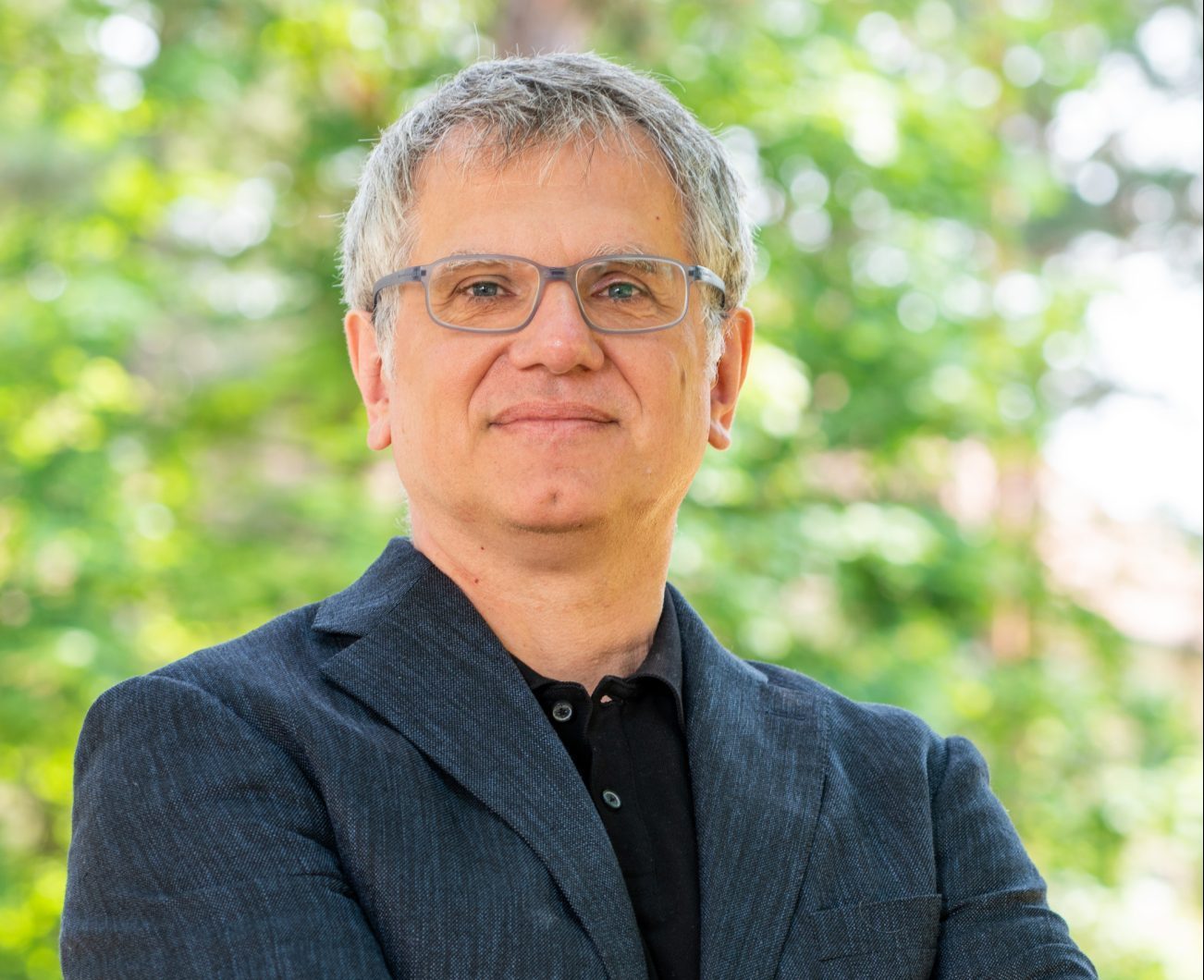
Prof. Dr. Alexander Schliep ist seit dem 01. Oktober 2022 FGW-Professor für Medizinische Bioinformatik mit dem Schwerpunkt patientenorientierte Datenerfassung an der Brandenburgischen Technischen Universität Cottbus-Senftenberg (BTU).
Große Datenmengen werden in vielen Disziplinen erhoben, oft mit höchst unterschiedlichen Formaten, die bioinformatisch bearbeitet werden müssen. Dazu ist es meist notwendig, neue Tools zu entwickeln, die für den Datensatz und die konkrete Fragestellung die bestmögliche Antwort liefern.
Darüber hinaus wird ein Schwerpunkt dieser Professur die Entwicklung neuer Techniken wie mobile Diagnostik oder vernetzte Versorgung chronisch kranker Menschen sowie die bias-freie Evaluation dieser neuen Techniken sein.
Das SchliepLAB ist Teil der Fakultät für Gesundheitswissenschaften Brandenburg und befindet sich an der Brandenburgischen Technischen Universität Cottbus-Senftenberg. Ein Teil der Gruppe ist an der Fakultät für Informatik und Ingenieurwissenschaften angesiedelt, die eine gemeinsame Fakultät der Universität Göteborg und der Chalmers University of Technology ist.
Eine Liste der laufenden und abgeschlossenen Forschungsprojekte finden Sie unter https://schlieplab.org/Research/, eine Liste der Veröffentlichungen unter https://schlieplab.org/Publications/ und eine Liste der Softwarepakete unter https://schlieplab.org/Software/.
Insbesondere für Antisense-Oligonukleotide (ASO), die durch RNAse H1-mediated Knockdown wirken, sind Bindungsenergien und Kinetik von ASO-mRNA-Duplexen entscheidend für die Vorhersage von Wirksamkeit und Sicherheit. Wir sagen Bindungsenergien anhand von Sequenzen voraus, untersuchen die Kinetik der ASO-Reaktionen, um den Entwurfsprozess von ASO-Medikamenten vorhersehbarer zu machen, und kombinieren in Kooperationsprojekten Molekulardynamik und künstliche Intelligenz, um Vorhersagemodelle für eine breitere Palette von Nukleotidmodifikationen zu erweitern. Unsere federated, privacy preserving Lernmethoden ermöglichen auch ohne Austausch von Daten ML-Modelle für die Vorhersage von Bindungsenergien zu lernen.
Pan-Genom-Graphen bieten einen prinzipiellen Ansatz für den Umgang mit strukturellen Variationen und, allgemein, dem hohen Grad an Variationen zwischen individuellen Genomen. ML auf Pan-Genom-Graphen wird es ermöglichen, Vorhersage- und Regressionsaufgaben für verschiedene Populationen zu bewältigen, einschließlich Größen, die für Oligonukleotid-Therapeutika relevant sind, wie Transkriptionsgeschwindigkeit oder DNA-Accessibility, sowie klinisch relevante Variablen.
Die von experimentellen Hochdurchsatzplattformen wie dem High-Throughput Sequencing (HTS) erzeugten Daten stellen eine rechnerische Herausforderung dar, insbesondere wenn fortschrittliche statistische Ansätze wie Bayes’sche Methoden zur Analyse verwendet werden. In der Vergangenheit haben wir einen komprimierenden Genomik-Ansatz entwickelt, der vom Big Data to Knowledge Program (BD2K) der NIH finanziert wurde, Wavelet-Kompression in Bayes’schen HMMs zur Erkennung von Kopienzahlvarianten eingesetzt und den Nutzen statistischer ML-Modelle, die Genome repräsentieren – Markov-Ketten variabler Länge – durch schnellere Lernalgorithmen erheblich verbessert. Dies ermöglicht z. B. alignementfreie Genomvergleiche aus Rohdaten.
Computational Thinking ist heute eine Grundvoraussetzung für fast alle Disziplinen. Die Vermittlung von algorithmischen Ideen kann von Software-Tools stark profitieren. Wir entwickeln Animationssysteme für Graphenalgorithmen, die auf dem Desktop, als Web-App und bald auch als iOS-App verfügbar sind; CATBox ist ein Springer-Lehrbuch, das Gato verwendet. Mit unserer Hidden Markov Model-Bibliothek können sich die Lernenden auf die Lösung spannender bioinformatischer Probleme konzentrieren.
Molecular biology is a scientific field which has undergone dramatic changes over the last four decades driven by novel scientific instruments such as sequencing machines allowing us to study genomes as well as gene activity. This has enabled a much deeper understanding of the molecular mechanism of life, evolution of species, and, very importantly, a better understanding of human disease.
A large part of the change was fueled by methods from Computer Science, most famously algorithms for comparing biological sequences (also known as approximate string matching) and for combining or assembling short sequences into complete genomes. As a matter of fact for large parts of bioinformatics the representation needed of biology is that of a string over the alphabet {A, C, G, T}.
The focus on sequence analysis in the course allows to focus on state-of-the-art methods in bioinformatics while keeping the biological background quite abstract and thus easily accessible also to students with a limited natural sciences or biology background.
The course will provide an introduction to modern bioinformatics and to selected applications from biology and medicine addressed with computational approaches based on classical algorithms and statistical machine learning, as well as modern deep learning approaches. The focus will be on four fundamental problem areas:
Detailed information for participants is available at https://www.b-tu.de/elearning/btu/course/section.php?id=157834.
| Lecture | Exercise |
|---|---|
| Fridays | Fridays |
| 11:30 – 13:00 | 9:15 – 10:45 |
| Campus Sachsendorf, Building 9, Room 9.219 |
The examination will take place on Aug 6, 2026, 14:00 – 16:00, Campus Sachsendorf, Building 15, Room 15V.110.
Drug Design is one of the most exciting fields where Artificial Intelligence (AI) has a measurable positive impact on human lives by greatly accelerating the complicated and failure-prone process of designing new drugs.
For this seminar we plan to focus on oligonucleotide and gene editing, two of the most modern approaches to treating disease.
Some biological concepts (DNA sequences, genes, gene expression) are necessarily part of the research articles which are the topic of the seminar. We will introduce those in an initial presentation also including the processes targeted by disease.
However, the machine learning methods often use simple abstractions such as the representation of a DNA sequence as a string over the alphabet {A, C, G, T}. In other words, no deep biological background is needed. Thus the seminar is accessible also to students with a limited natural sciences or biology background.
Students will present a topic based on—typically—one original research article chosen from a list of suggestions made available here and prepare a report on the same topic. Attending all talks by other students and participating in discussions is expected for a passing grade.
Detailed information for participants is available at https://www.b-tu.de/elearning/btu/course/view.php?id=14656.
| Seminar |
|---|
| Fridays |
| 13:45 – 15:15 |
| Campus Sachsendorf, Building 9, Room 9.219 |
Detailed information for participants is available at https://www.b-tu.de/elearning/btu/course/view.php?id=14662.
| Laboratory |
|---|
| Thursdays |
| 13:45 – 15:15 |
| Campus Sachsendorf, Building 9, Room 9.115 |
Detailed information for participants is available at https://www.b-tu.de/elearning/btu/course/view.php?id=14663.
| Laboratory |
|---|
| Wednesdays |
| 13:45 – 15:15 |
| Campus Sachsendorf, Building 9, Room 9.115 |
After successfully completing the module, students will be familiar with state-of-the-art problems and methodological approaches used in medical bioinformatics. They will have the ability to familiarize themselves with current research in medical bioinformatics from original research literature, to participte in a technical discussion within the context of international science and present scientific content in written and oral form.
Students will learn about specific state-of-the-art problems and methodological approaches used in medical bioinformatics. The applications will range from diagnostics and monitoring patients with sensor, clinical and omics data, to detect clinically relevant states or understand cellular processes relevant to diagnosis and disease as well mechanisms for treating diseases. Methods will include both algorithmic and machine learning approaches.
Detailed information for participants is available at https://www.b-tu.de/elearning/btu/course/view.php?id=14661.
| Seminar |
|---|
| Thursdays |
| 15:30 – 17:00 |
| Campus Sachsendorf, LG 9, HS 9.219 |
The meetings will take place on Tuesdays, 13:00 – 14:00, Campus Sachsendorf, building 9, room 9.317.
Detailed information for participants is available at https://www.b-tu.de/elearning/btu/course/section.php?id=157963.
The research module helps students to prepare for a Master’s thesis in the areas of medical bioinformatics, particularly with using Machine learning and AI methods. The format are weekly meetings in which students read an original research paper, prepare a project proposal and a project plan for a possible thesis project based on the original research paper after some preliminary analysis. The writing process, the formulation of scientific questions and the design to address them are important initial steps in the Master’s process.
There will be weekly meetings, time and day of week by arrangement.
About the field:
Molecular biology and biomedicine are scientific fields which have undergone dramatic changes over the last four decades driven by novel scientific instruments such as sequencing machines allowing us to study genomes as well as gene activity. This has enabled a much deeper understanding of the molecular mechanism of life, evolution of species, and, very importantly, a better understanding of human disease.
A large part of the change was fueled by methods from Computer Science, most famously algorithms for comparing biological sequences (also known as approximate string matching) and for combining or assembling short sequences into complete genomes. As a matter of fact for large parts of bioinformatics the representation needed of biology is that of a string over the alphabet {A, C, G, T}.
Consequently, by keeping the biological background quite abstract research on state-of-the-art methods in bioinformatics is easily accessible also to students with a limited natural sciences or biology background.
Detailed information for participants is available at https://www.b-tu.de/elearning/btu/course/view.php?id=14658.
A list of current and prior offered courses and seminars can be found at https://schlieplab.org/Teaching/